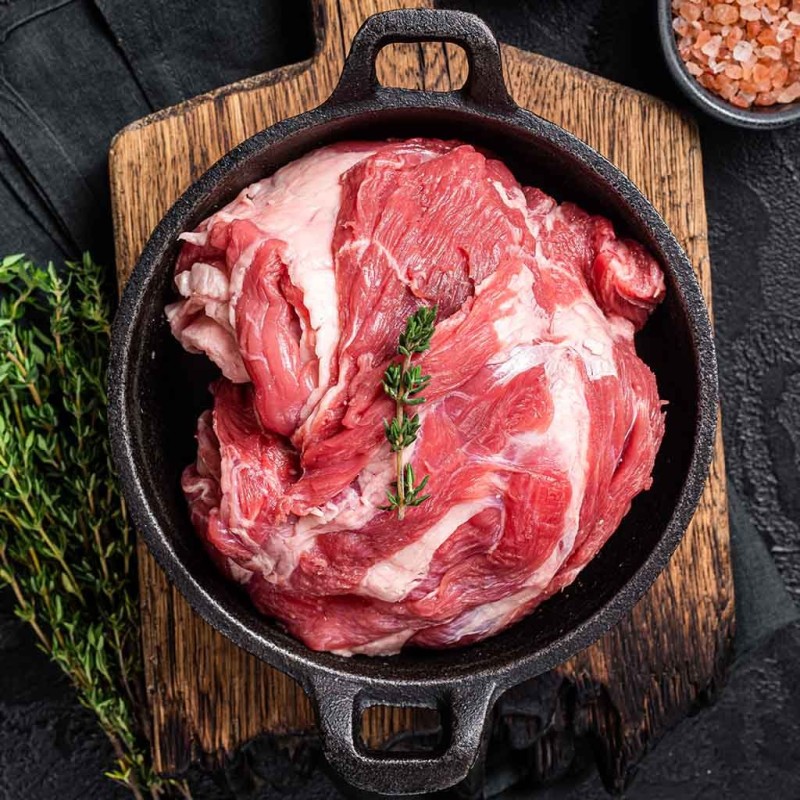
What is boneless lamb shoulder?
It's the front part of the carcass, known for having more fat and fibers that transform into a soft, juicy texture when cooked slowly. The boneless version is more convenient to prepare and more versatile.
This meat is made for slow cooking—not quickly, but with very good results.
How does it taste and what makes it special?
Lamb shoulder has an intense, distinctive flavor, more pronounced than lamb. Due to its fat content, the meat doesn't dry out and gains depth.
After preparation:
- it is very tender,
- it falls apart easily,
- it has a rich, slightly fatty taste that pairs well with spices.
It's a piece that forgives mistakes—even if you extend the stewing time a bit, it will still be good.
What to use it for?
This meat is perfect for dishes that require time.
It's great for:
- lamb stew,
- braising in its own sauce,
- one-pot meals,
- oriental cuisine (e.g., with aromatic spices),
- baking at low temperatures.
It pairs with:
- groats,
- potatoes,
- bread,
- root vegetables,
- sour additions (e.g., pickles, lemon).
How to prepare it to be tasty?
The best results are achieved with long stewing or slow roasting.
Basic stewing method:
- Cut the meat into larger pieces.
- Sear on high heat.
- Add onion, garlic, and spices.
- Pour in broth or water.
- Stew on low heat for 1.5–3 hours.
- Serve when the meat is tender and falls apart under a fork.
You can also bake it at low temperature (150–170°C), covered, for several hours.
If the taste is too intense for you, add something acidic—like tomatoes or a touch of lemon.
Who is this product for?
This meat is for those who:
- enjoy bold flavors,
- cook one-pot meals,
- are not afraid of longer preparation times,
- are looking for meat that will be truly juicy.
It's a good choice for a hearty dinner, especially on colder days.
How many calories does boneless lamb shoulder have?
Exact caloric content is not provided.
In practice:
- it is fattier meat,
- very filling,
- best served with accompaniments that balance the flavor.
Nutritional values
No specific numerical data available.
In practice:
- provides protein,
- contains fat responsible for flavor and texture,
- satisfies well and provides energy.
Composition
100% lamb meat (boneless shoulder).
Practical information before purchase
...
Boneless shoulder is easy to divide — you can prepare it whole or cut it into pieces for stew. It's a meat that is worth preparing in advance and simmering slowly.
This is not a piece for quick frying — it tastes best after longer processing.
Description prepared according to product content creation guidelines.
Fun Fact
- Shoulder is one of the most commonly used cuts of lamb in traditional cooking.
- Long cooking makes the meat exceptionally tender and aromatic.
FAQ
Is lamb shoulder tough?
Initially, yes, but it becomes very tender after longer simmering.
Do you need to marinate it?
It's not necessary, but seasoning beforehand enhances the flavor.
Is it suitable for quick frying?
No — it's better to simmer or roast it.
How to mellow the taste of lamb?
Add garlic, spices, and something acidic, like tomatoes or lemon.
Recipes
1. Lamb Shoulder Stew
Preparation time: about 2.5 hours
Ingredients:
- Boneless lamb shoulder
- 2 onions
- 3 cloves of garlic
- Broth
- Sweet paprika
- Olive oil
- Salt, pepper
Steps:
- Cut the meat into pieces.
- Sear until golden.
- Add onion and garlic.
- Add paprika and pour in broth.
- Simmer on low heat until tender.
- Serve with groats or bread.
Tip:
Don't rush — longer simmering gives a better flavor.
2. Slow Roasted Lamb Shoulder
Preparation time: about 3 hours
Ingredients:
- Lamb shoulder
- Garlic
- Rosemary
- Olive oil
- Salt, pepper
Steps:
- Rub the meat with spices.
- Let it rest for several hours.
- Roast at 160°C covered.
- Baste during roasting.
- Serve when the meat is very tender.
Tip:
Uncover the meat at the end to let it brown slightly.
Summary
Boneless lamb shoulder is for those who enjoy a robust flavor and juicy texture. Due to its higher fat content, it withstands long cooking well and practically doesn't dry out. It's best in stews, braising, and slow roasting, where the meat becomes tender and aromatic. It's a good choice for a hearty lunch or a one-pot dish. The absence of bones facilitates preparation and portioning. If you like meat that 'does the work' in the pot and delivers a lot of flavor, this is a very good choice. All it takes is time and simple additions to achieve a really solid effect.

 Polski
 Deutsch



 DEEP-FROZEN PRODUCT